"How much does an illustration cost?" is a bit like "how much does a house cost?" The honest answer is that it depends, but it depends on things you can name, and once you know them you can plan a budget and compare quotes sensibly.
I do not publish a price list, because two jobs that sound alike can be very different in practice. A "frog illustration" might be a quick line drawing for a worksheet or a fully painted species plate checked by a herpetologist and licensed for a textbook series. Instead, here is what actually moves the number, how quotes are put together, and how to get an accurate one.
What drives the cost
1. The subject and the number of views
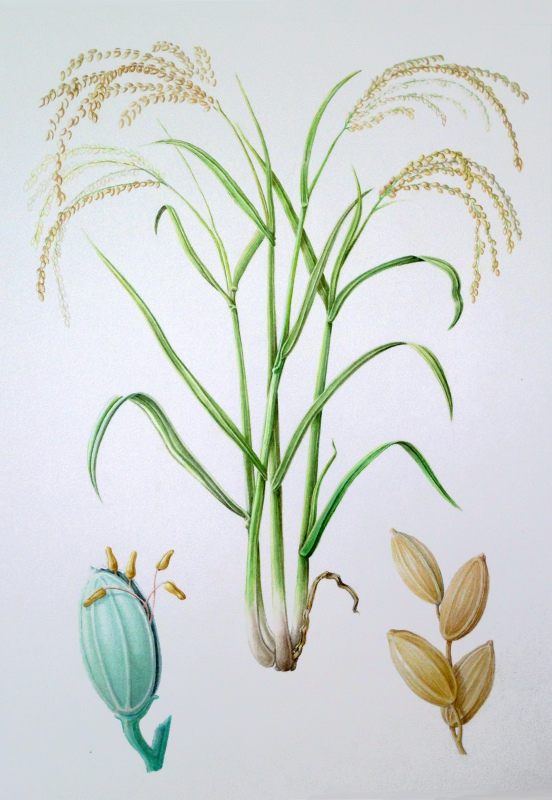
Complexity is the biggest single factor. A smooth seed is quicker to draw than a bird with every feather in place, and a single view is quicker than a plate with several. My African rice plate, for example, is really three drawings on one page: the whole plant, an enlarged floret and a cluster of grains. Each one needs its own references, measurements and checks.
2. Research and expert review
Accuracy takes time that does not show in the finished picture: reading descriptions, gathering references, studying specimens and making corrections after the expert has seen the sketch. A common species with good references needs less of this than a newly described one or a reconstruction of something nobody has ever seen alive.
3. Medium, detail and size
Media take different amounts of time. Stippled ink tone is built one dot at a time, and a layered watercolor plate needs drying time between stages. Digital work can be faster to revise. Larger final sizes need more finished detail, because more is visible. I compare the main options in Pen and Ink vs Watercolor for Science Art.
4. Color or black and white
Full color usually takes longer than black and white, and color for print needs careful proofing. If the publication prints in one color, art made for black and white is both cheaper and better than a color painting converted to grayscale.
5. Rights and usage
This is the factor clients most often overlook. The fee covers the right to use the image, not only the hours spent making it. A non-exclusive license for one book costs less than exclusive rights across all media and editions, and a full buyout costs more again. I explain the options in Illustration Licensing: What Publishers Should Know.
6. Schedule
A comfortable schedule keeps costs down. A rush job means rearranging other work, and it leaves less time for review, which raises the risk of costly corrections late in the process.
7. Revisions
Agreed review rounds are part of the quote. Changes after the content was approved, such as a new pose, a different species or a new layout, are extra work and are usually charged separately.
8. Extras and deliverables
Labels and leader lines, layered files for animation, unlabeled versions for quizzes, poster-size files, travel to a collection or a site: each adds a little, and each should be listed so nobody is surprised.
How a quote comes together
Every commission I take follows the same path, and the quote sits near the start of it:
- Your brief. What needs explaining, for whom, at what size, in color or black and white, how many images and by when.
- My questions. I usually come back with a few: which references exist, who will review the science, which uses you need.
- A written proposal. The approach and medium, the number and size of images, review rounds, the rights included, the schedule and the fee.
- Agreement. Scope, rights and payment terms are written down and signed before work begins. The agreement should also say what happens if the project is canceled partway through.
- The work. If the scope changes along the way, we update the agreement rather than guessing.
Where to get a sense of typical rates
Rates vary with experience, location, the type of client and the rights involved, so any single figure you find online should be treated with caution. Better sources are the pricing surveys and guidelines published by professional bodies, such as the Graphic Artists Guild's handbook on pricing and ethical guidelines, and conversations with illustrators through organizations like the Guild of Natural Science Illustrators. If you ask several illustrators to quote on the same written brief, the quotes will be much easier to compare.
How to keep the budget under control
- Settle the content first. Agree on species, stages and labels with your author or expert before sketches start.
- Supply good references. Specimens, measurements and the author's own photos save research time.
- Combine images where it makes sense. One well-planned plate can replace several separate figures.
- License what you need. Do not buy all rights for a single-use poster; do plan ahead for editions you know are coming.
- Allow time. A realistic schedule is the easiest saving there is.
- Reuse layered art. A labeled poster, an unlabeled quiz version and a worksheet line version can come from one drawing, as I describe on my life cycle diagrams page.
What to send for an accurate quote
The more of this you can include in your first message, the closer my first quote will be to the final number:
- The subject, with scientific names if you have them
- The use: book, journal, exhibit panel, poster, website
- Final size, and color or black and white
- How many images, and whether any are plates with several views
- Who will check the science
- The rights you need: media, editions, territory, exclusivity
- Your deadline and any fixed dates, such as a print date or an exhibit opening
- A budget range, if you have one. It helps me suggest an approach that fits rather than quoting blind.
If your project is a plant plate or portrait, my botanical illustration commissions page explains how those work in detail. When you are ready, send me your brief and I will reply with questions and a proposal.