Illustration services
Archaeological Reconstruction Illustration
Archaeology recovers pieces: stains left by rotted posts, broken pottery, a hearth, a handful of charred seeds. A reconstruction puts them back together into a picture people can understand. I draw evidence-based reconstructions of past places and daily life for archaeologists, heritage sites, museums and publishers.
- Every detail traced to a source
- Reviewed by your archaeologist
- Uncertainty handled openly
- Reference log delivered with the art
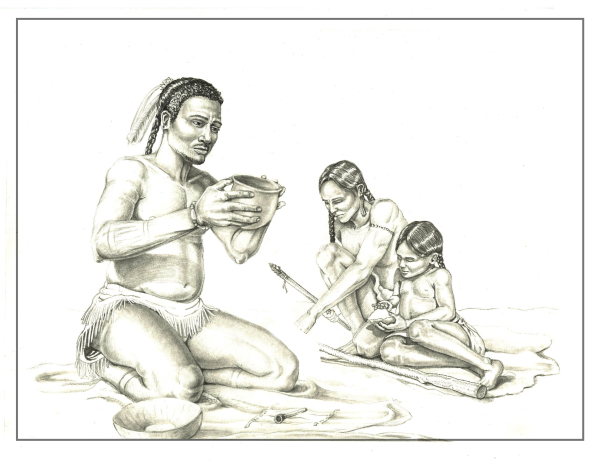
Reconstructions for reports, panels and programs
Daily-life scenes
A few people at work, with the tools, food and objects the excavation recovered shown in use.
Site and settlement views
A bird's-eye view of houses, hearths, pits and paths in their landscape, drawn from the excavation plan.
Structures
Houses and shelters rebuilt from post-mold patterns, with construction steps when they help.
Artifact drawings
Pottery, stone tools and other finds in standard views with a scale, in ink or stipple for reports.
Past landscapes
Rivers, vegetation and wildlife as the evidence suggests they were, not as they look today.
Cutaways and profiles
Soil layers, features and the sequence of occupation, drawn so non-specialists can follow them.
Evidence first, and honest about the gaps
A reconstruction is a visual hypothesis. Its value depends on how well each part of it is supported, and on being clear about the parts that are not.
Where each detail comes from
- Excavation plans, profiles and feature records
- Artifacts and their dates
- Plant and animal remains
- Comparative sites and early written accounts
- The interpretation of the project's archaeologist
When the evidence runs out
- Show the most likely option
- Keep the detail soft or in shadow
- Leave it out of the frame
- Show alternatives side by side
Every choice goes into a reference log, so docents, teachers and readers can answer the question "how do we know?"
I grew up in the wetlands near the Pee Dee River, and the Kolb site, on the Great Pee Dee in Darlington County, is part of that same landscape. People returned to it over thousands of years, which is exactly what makes it hard to draw: each layer belongs to a different time, and a scene has to choose one moment and stay true to it. When a reconstruction depicts the ancestors of living people, I also encourage involving their communities in the review.
Who I work with
- Archaeologists and university projectsFigures for reports, articles and books, and images for public talks.
- Cultural resource management firmsPublic outreach products and report illustrations.
- Heritage preserves, parks and historic sitesTrail signs and visitor panels at the site itself.
- Museums and visitor centersExhibit scenes, as on my museum illustration page.
- Publishers and educatorsBooks, textbooks and classroom materials about the human past.
How a commission works
Brief
You contact me with the site, the question the image should answer, where it will be used and your deadline.
Evidence review
I read the reports and records you share and list what the evidence supports and where the gaps are.
Proposal and agreement
An approach, a viewpoint, a medium, a schedule and a quote, with review rounds and rights agreed up front.
Sketches and review
Thumbnails, then a tight pencil drawing, both checked by your archaeologist before rendering.
Final art
Rendered in graphite, ink, color or digital paint, whichever suits the evidence and the use.
Delivery
Files to your specifications, with the reference log that documents each choice.
I describe the whole process, with the Kolb site drawing as an example, in How Archaeological Site Reconstructions Are Drawn. For what affects the fee, see How Much Does Scientific Illustration Cost?
Frequently asked questions
How do you avoid showing more than the evidence supports?
Every element goes into a reference log marked as excavated evidence, reasonable inference or informed guess. Where the evidence runs out, we choose together whether to show the most likely option, keep the detail soft, or leave it out.
Can you draw artifacts for a technical report?
Yes. Pottery, stone tools and other finds can be drawn in the standard views with a scale, usually in pen and ink or stipple so they reproduce cleanly in black and white.
Can one drawing serve both a report and a public sign?
Often, yes, if we plan for it. Tell me about every intended use at the start so the composition, the file sizes and the license cover them all.
What if new evidence turns up later?
Art finished digitally or kept in layers can be updated far more easily than a single painting. If your excavation is still running, we can plan the image so that likely changes stay simple.
Have a site with a story to tell?
Tell me about the site, the evidence and how the image will be used, and I will reply with questions and a proposal.