Illustration services
Life Cycle Diagrams for Science Education
A life cycle is a story told in a circle. I draw life cycle diagrams of amphibians, insects, plants, fungi and parasites, with every stage researched and arranged so a student can follow the sequence without help.
- For teachers, curricula, textbooks and e-learning
- Labels in your curriculum's terms
- Unlabeled and layered versions
- Checked by an expert and a teacher
What makes a life cycle diagram work
Life cycles are some of the most useful images in science education and some of the easiest to get wrong. Stages get skipped, sizes get confused, and arrows make sense to the artist but not to a twelve-year-old.
One reading direction
A clear starting point, usually clockwise, with arrows that mean only "this becomes that."
Honest scale
Insets, magnification notes or scale bars, so students do not think a spore is as big as a frog.
Context
Each stage shown where it lives: in water, in soil, on a leaf, in a host.
Consistent vocabulary
Labels that match your curriculum, so the poster and the lesson use the same words.
Color with a purpose
Chosen so the diagram still reads for color-blind students and when photocopied in grayscale.
The right level of detail
A simple four-stage loop for younger students, a detailed cycle for high school or college.
My goal, which I call "educational aesthetics," is a diagram that is clear, accurate and interesting, and beautiful enough that students want to look at it.
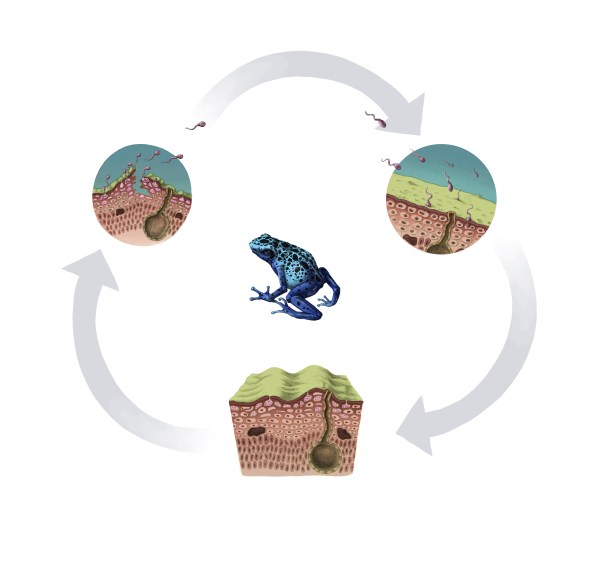
The chytrid fungus, in three stages
One of my favorite projects is a life cycle of the chytrid fungus that infects amphibians, Batrachochytrium dendrobatidis. It is a hard subject to show: the fungus is microscopic, it lives in the outer layers of an amphibian's skin, and the disease it causes has been linked to serious declines in amphibian populations around the world.
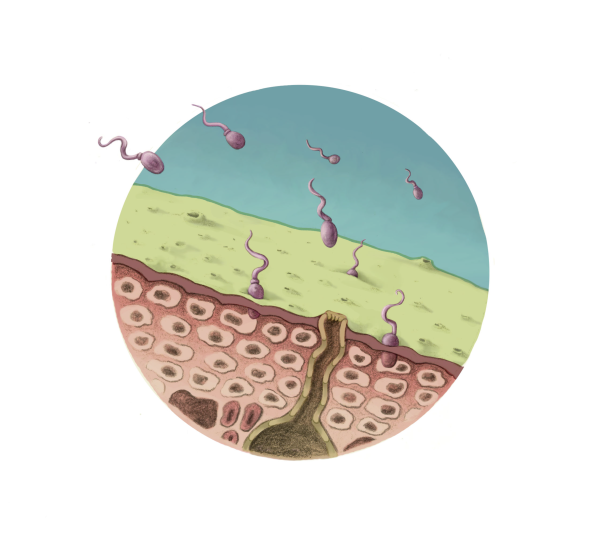
Zoospores arrive
Free-swimming zoospores reach the skin and settle on it.
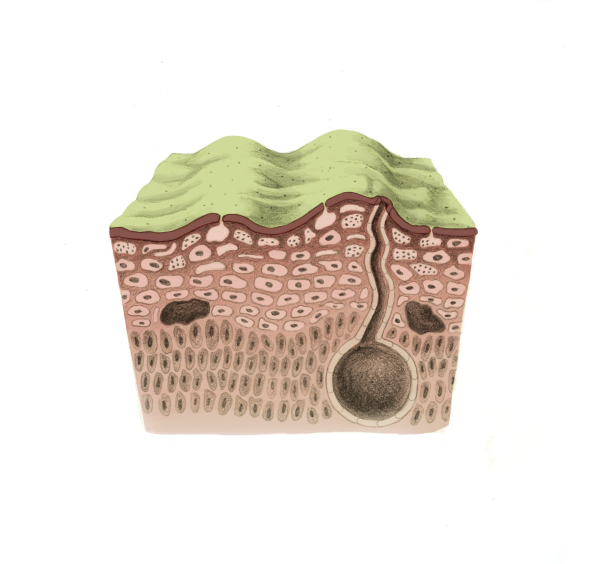
The sporangium grows
The fungus has grown into a sporangium inside the skin, with its discharge tube reaching the outer layer.
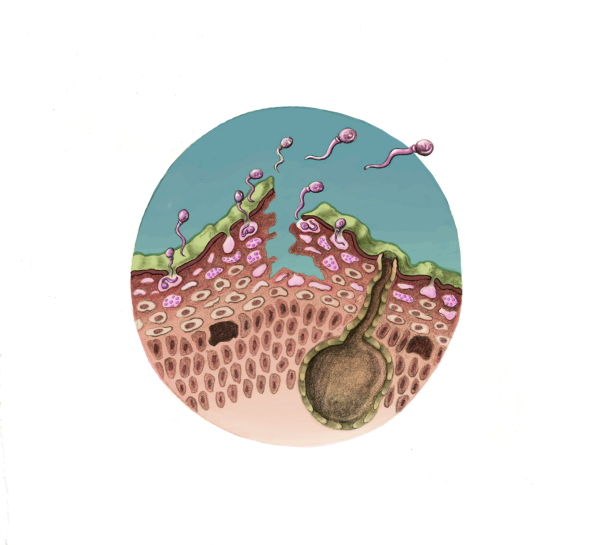
New zoospores escape
New zoospores escape through a discharge tube to the surface, ready to start again.
In the finished diagram the three cutaways sit in a cycle around a blue poison dart frog. The frog connects the microscopic stages to an animal students can picture, and the round insets make it clear that these are magnified views.
See all three stages in the galleryLife cycles I draw
Amphibians
Egg mass, tadpole, tadpole with legs, froglet and adult, plus the parasites and diseases that affect them.
Insects
Complete metamorphosis (egg, larva, pupa, adult) and incomplete metamorphosis (egg, nymph, adult), shown on the host plants where they actually live.
Plants
Seed, germination, seedling, flowering, pollination, fruit and seed dispersal, and alternation of generations in ferns and mosses.
Fungi and microorganisms
Spores, hyphae, fruiting bodies and microscopic stages, with clear cues for magnification.
Parasites with several hosts
Where the diagram has to show which stage happens where.
- Pen and ink or digital line artClean line work for worksheets students will label or color.
- Watercolor and digital paintingPosters and textbook figures.
Who I work with
- Teachers and schoolsClassroom posters and handouts that match what you teach.
- Curriculum developers and educational publishersUnits, textbooks and assessments.
- Digital learning teamsE-learning courses, apps, slides and interactive lessons.
- Museum and nature center educatorsSchool programs and family activities.
- Researchers doing outreachExplaining your study organism to students or the public.
How I keep it accurate
Research
Textbooks, scientific papers and the curriculum standards you are working to.
Specimens and micrographs
I draw from specimens and references whenever I can, and for microscopic subjects I work from micrographs and published descriptions.
Expert review
Sketches are reviewed by a subject expert: your author, a scientist you work with, or a specialist we agree on.
Readability check
A teacher reviews the same sketches. If you can, show the sketch to a few students before the final; their confusion is the best editing tool I know.
How a commission works
Brief
You send me the organism, grade level, intended use (poster, worksheet, textbook, screen), the vocabulary you use, and your schedule.
Proposal
I reply with questions, an approach, a timeline and a quote, and we agree on scope, review rounds and rights.
Research and layout sketch
I research the stages and send a rough layout showing the order, the arrows and where labels will go.
Detailed sketch and expert review
Your expert checks the science, and your teacher or editor checks readability.
Final art
I render the final and send it for a last check of labels and details.
Delivery
The final files plus any agreed versions: unlabeled, black and white, or layered for animation.
What you receive and how you can use it
Formats, print and digital
- For print, high-resolution files sized to the final format, from a textbook figure to a classroom poster. Tell me the largest size you plan to print, because a poster needs art prepared for it from the start.
- Web-ready images for screens.
- For interactive lessons, layered files with each stage, arrow and label separate.
- Worksheet versions with blank label boxes, produced from the same art.
Rights and licensing
Diagrams are licensed for the uses we agree on: a curriculum, a textbook and its digital edition, a set of posters, an online course.
- Expect to reuse the diagram across grade levels, products or future editions? Say so at the start and the license will cover it.
- Exclusive rights and buyouts are possible and are priced to match.
Unless agreed otherwise, I keep the copyright and may show the finished work in my portfolio.
Frequently asked questions
Can I get a version without labels for quizzes?
Yes. Labels are kept on their own layer, so an unlabeled version, or one with numbered blanks, takes very little extra work.
Can the diagram use our curriculum's terms?
Yes. Send me your vocabulary list or standards, and the labels will match them exactly.
Do you make animations?
I prepare layered art for animation and interactive use. The animation itself is usually done by your digital team or animator, and I am happy to work with them.
Will it print well as a large poster?
It will if I know the size in advance. I plan the drawing and the resolution for the largest format you intend to print.
Need a life cycle drawn?
Tell me the organism, the grade level and how the diagram will be used, and I will reply with questions and a proposal.