Illustration services
Scientific Illustration Services for Publishers
Species plates, botanical and anatomical drawings, cutaways and process diagrams for books and journals. Every piece is researched, checked by the people who know the subject best, and drawn for the size and format your book or journal will actually use.
- Researched and expert-reviewed
- Graphite, pen and ink, watercolor, digital
- Files to your production specifications
- Review rounds set in the agreement
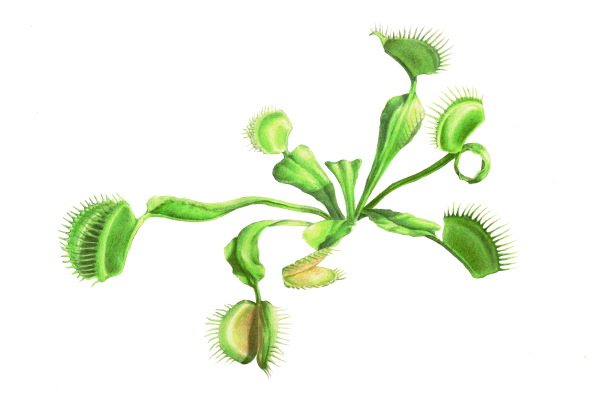
How I keep the science right
A published illustration gets reprinted and used in classrooms for years, so a mistake in it travels. My process is built to catch errors early, while they are cheap to fix.
Research first
I read species descriptions, the manuscript and the papers the author recommends, and note the diagnostic features a specialist uses to tell a species from its relatives.
Specimens and references
Whenever possible I draw from the real thing, and combine several references rather than copying one photograph, to show a clean, typical example.
Expert review
Pencil sketches go to the author, scientist or subject editor before rendering begins. Most corrections happen here: a proportion, the angle of a limb, the number of veins in a leaf.
Agreed review rounds
Review rounds are written into the agreement, usually at the sketch stage and before delivery, and labels are checked against the manuscript.
I studied Illustration at the Savannah College of Art and Design and took biology, anthropology and biomimicry alongside my core classes, because I wanted to understand what I was drawing. My motto is "educational aesthetics": an image should be clear, accurate and interesting, and also beautiful, because a reader who enjoys a picture keeps looking long enough to learn from it.
Images for books and journals
Most book and journal work falls into a few kinds of image.
Species plates and portraits
Plants, animals and fungi drawn from specimens and references, showing the typical form of the species rather than one damaged or unusual individual.
Botanical plates
The whole plant with enlarged details of flowers, seeds and leaf structure, as in my plate of African rice (Oryza glaberrima).
Cutaways and cross-sections
What lies under a surface, from the layers of amphibian skin to the inside of a seed.
Process diagrams and life cycles
Stages, arrows and labels arranged so the sequence reads at a glance. More on the life cycle diagrams page.
Reconstructions
Extinct animals, past landscapes and archaeological scenes, built from the evidence that survives.
- Pen and inkReproduces cleanly in one color and at small sizes, which suits journals, keys and field guides.
- GraphiteDetailed tonal work for black and white interiors.
- Watercolor and digitalColor plates and covers. Digital files make later corrections much easier.
Plates and figures
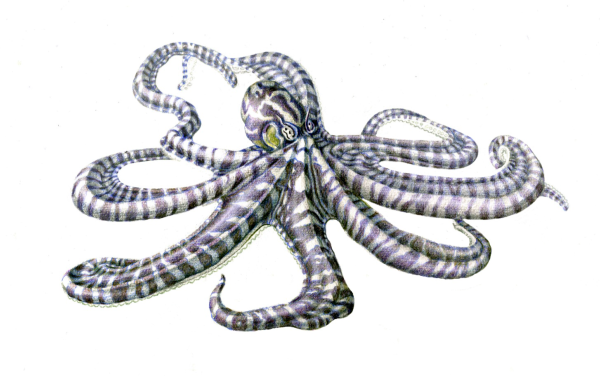
Mimic octopus (Thaumoctopus mimicus), arms spread to show the full banded pattern. 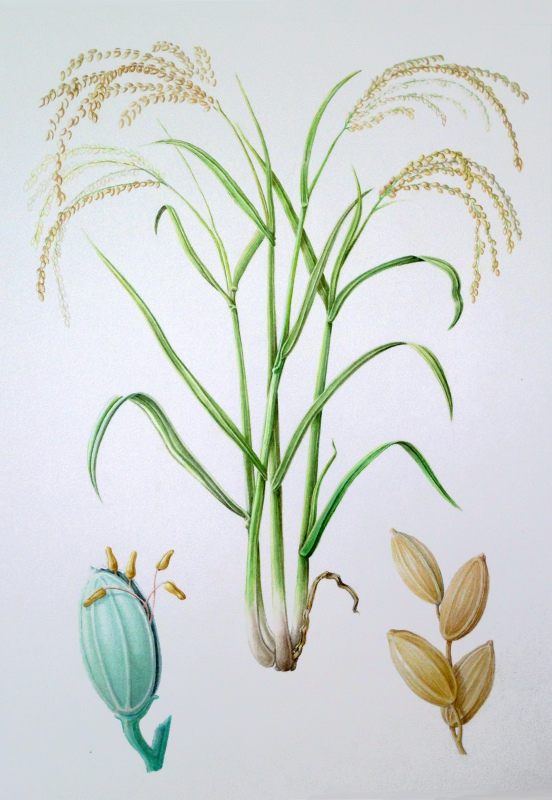
African rice (Oryza glaberrima): the whole plant with enlarged details. 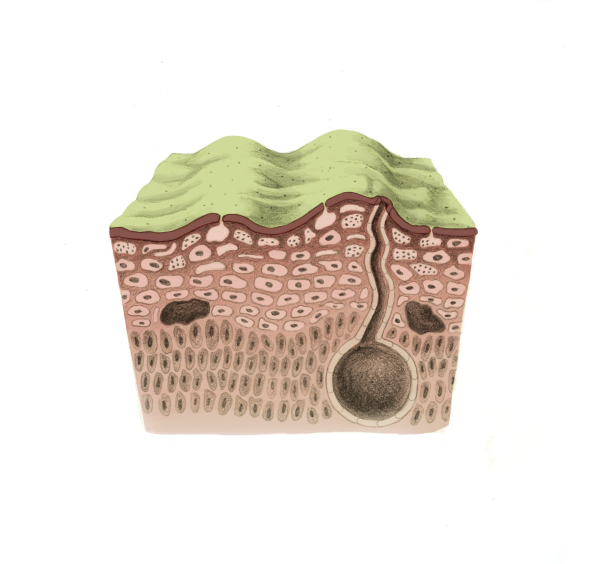
A cutaway of amphibian skin, from a chytrid fungus life cycle. 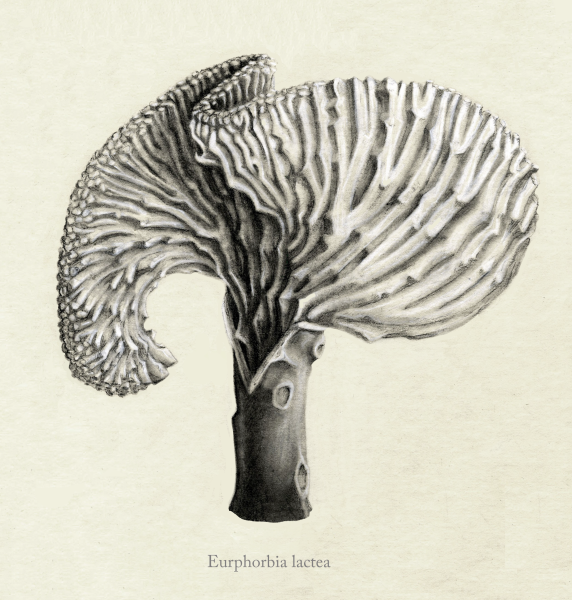
Euphorbia lactea, in black and white.
More species plates, cutaways and life cycles are in the gallery.
See the galleryWho I work with
- Textbook publishersBiology, ecology or earth science figures that hold up to review by subject editors and stay consistent across a whole program.
- Journals and research authorsA figure a photograph cannot provide: a reconstruction, a cross-section, a habitus drawing or a graphical abstract.
- Field guide publishersSpecies plates drawn in a consistent pose, scale and light, so readers can compare one plant or animal with the next.
- Trade nonfictionAuthors and editors writing about natural history, evolution, medicine or archaeology for general readers.
- Children's science booksFriendly and inviting without becoming inaccurate. A child who learns the wrong number of legs on an insect has to unlearn it later.
How a commission works
Brief
You get in touch with the subject, the intended use, the figure or trim size, color or black and white, the number of images and your schedule.
Proposal
I reply with questions, a suggested approach and medium, a timeline and a quote. Once we agree on scope, rights and schedule, the work starts.
Research and thumbnails
I gather references and send small compositional sketches to settle the layout, the view and what each figure needs to show.
Tight sketch and expert check
A detailed pencil drawing goes to you and your expert for accuracy review.
Final art
After corrections, I render the final in the agreed medium and send it for a last review.
Delivery
Production-ready files, with labels on separate layers or as editable type if your designers will set them in the book's fonts.
What you receive and how you can use it
Files for print and digital
I deliver to your production specifications.
- For print: high-resolution TIFF or layered PSD files, commonly 300 to 600 ppi at final printed size (higher for fine line art).
- RGB or CMYK, as your production team prefers.
- Line art and labels can also be supplied as vector files.
- Versions sized for the screen for ebooks, websites and slides.
Traditional pieces are scanned at high resolution, and the original art stays with me unless we agree otherwise.
Rights and licensing
Most publishing commissions are licensed rather than sold outright.
- The license covers the uses you need, such as a print edition and its ebook, and is written into the agreement before work starts.
- Expect later editions, translations or marketing use? Tell me at the brief stage.
- Broader or exclusive rights are possible and are priced to match.
Unless the agreement says otherwise, I keep the copyright and may show the work in my portfolio after publication.
Frequently asked questions
Can you work from the author's own photographs and specimens?
Yes, and I prefer it. Material from the researcher is often the best reference available, especially for new or rarely seen species. I will ask for several views of each subject and a scale reference.
How far ahead should we book?
As early as you can. A single species plate can move quickly, but a full set of figures for a book needs time for research and review. Tell me your print date and I will tell you honestly whether the schedule works.
Can you match the style of our existing books?
Yes. I can work to a style guide covering line weights, color palette, label fonts and figure dimensions. Send sample spreads and the guide with your brief.
Will you add labels and leader lines?
I can letter the labels myself, or supply leader lines and numbered callouts on a separate layer so your designers can set the type.
Have a book or journal figure in mind?
Send me the subject, the format and your schedule, and I will reply with questions and a proposal.