Most octopuses survive by disappearing. They match the rock, slip into a crack and wait. The mimic octopus lives where there is nothing to hide behind, so it does something stranger: it pretends to be other animals, and dangerous ones at that.
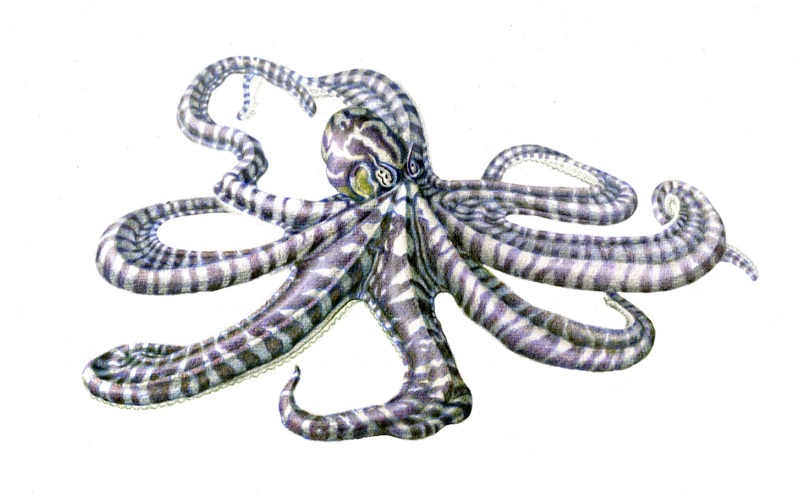
Meet the mimic octopus
Thaumoctopus mimicus was first noticed by divers in 1998 off Sulawesi, Indonesia, on the muddy bottom near a river mouth, and it was formally named in 2005. It lives in the tropical Indo-West Pacific, mostly in shallow water on sand and silt, often in estuaries rather than on coral reefs. It is a slender animal, about 60 cm long at most with its arms included, and the arms are thin, roughly pencil-thick at their widest.
At rest it is a plain light brown. When it is moving or disturbed it can switch on bold brown-and-white bands along its arms and body. Those bands are the key to the whole act.
The impressions
Researchers and divers have described several distinct performances. Each one combines three things an octopus can control: color, body shape and movement.
The flatfish
The octopus draws its arms together behind its body into a flat, leaf-like shape and swims low over the sand with jets from its siphon, rippling like a sole. In one study a single animal was seen doing this hundreds of times over a few days, which suggests the flatfish is its everyday disguise while it travels between feeding spots. Some banded soles in the region are thought to be distasteful to predators, which would make the disguise more useful.
The lionfish
Hovering above the bottom, the octopus spreads its banded arms out around the body and lets them trail. The effect resembles the long, striped spines of a lionfish, a fish few predators want to bite.
The sea snake
This is the famous one. The octopus pushes its body and six arms into a burrow, then stretches the remaining two arms out in opposite directions and waves them, so that what shows above the sand is a long black-and-white banded body, like a venomous banded sea snake. In the first published study of the species, an octopus performed this display when it was being harassed by damselfish. Banded sea snakes hunt damselfish, so the octopus appeared to choose the one model that particular attacker had reason to fear.
Other forms
Observers have also described the octopus rising with its arms trailing below the mantle like a jellyfish, and imitating still objects such as sponges and tubes. Not every reported impression is equally well documented, and it is fair to treat the rarer ones with some caution.
Why the bluff works
Biologists call this kind of trick Batesian mimicry: a harmless or edible animal copies the warning signals of a dangerous one, and predators that have learned to avoid the dangerous model leave the copy alone too. A few features make it work especially well here.
- Predators decide fast. A fish hunting over open sand has a fraction of a second to judge whether a target is food or trouble. The mimic does not need to be perfect, only convincing enough to cause hesitation, and hesitation is often enough to escape.
- Bold bands are an old warning. Strong light-and-dark banding is shared by many animals that sting, bite or taste bad, so it carries a general "do not touch" message even before the predator identifies the model.
- It can change the act. A fixed disguise works against some predators and fails against others. An animal that can switch between models can, in principle, show each attacker the threat it respects most. The damselfish and sea snake observation is the best example.
- The models live nearby. Mimicry only pays where predators have met the real thing. The flatfish, lionfish and sea snakes it copies share its waters.
One open question is whether the octopus is purely bluffing. Its own toxicity has not been established, so it may be entirely harmless, or it may have some chemical defense of its own. Either way, the performance clearly buys it time.
The act also makes a very unusual lifestyle possible. Many octopuses forage at night and hide in dens by day. The mimic octopus hunts in the open sand, probing burrows with its long arms for small fish, crustaceans and worms. Being able to look dangerous is what lets an animal with no shell and no rock to hide behind do that.
A mimic of the mimic
The story has one more twist. Divers off Indonesia photographed a small jawfish swimming close against the arms of a foraging mimic octopus. The fish had similar brown-and-white banding and seemed to be using the octopus as cover, so that predators saw only one large banded animal. It is a single observation, but it shows how far a good signal can travel through an ecosystem.
What drawing it taught me
The pose in my illustration is not one you would see on a dive. A living mimic octopus rarely sits with all eight arms neatly spread. I chose a standard view from above for the same reason field guides do: it shows the whole animal, the proportions of the arms against the mantle, and the full banding pattern at once. In a scientific illustration, clarity outranks drama.
The banding was the hard part. Bands on a curling arm are not stripes painted on a tube. They narrow as the arm tapers, bend around each curve and foreshorten where the arm turns toward or away from you. Every band had to follow the form or the arm would flatten into a ribbon. Working that out made me appreciate how much the octopus relies on the same geometry: the bands read as "snake" or "lionfish" only because the animal shapes its arms to make them read that way.
The colors are deliberately restrained, soft browns and grays rather than high contrast, because the animal's natural color is muted and the bands are something it chooses to show. If you want to see how the piece sits next to my other species portraits, it is in the gallery. For a very different animal story, told from inside a frog's skin, read Chytrid Fungus and Frogs: A Life Cycle Explained.
If you are writing about animal behavior and need a figure that shows a sequence or a posture photographs cannot capture, see my scientific illustration services for publishers.