At the Savannah College of Art and Design I majored in illustration, but some of the classes that shaped me most were outside it: biology, anthropology and biomimicry. Biomimicry in particular changed the questions I ask when I draw. I stopped asking only "what does this look like?" and started asking "what does this do, and how?"
What biomimicry is
Biomimicry is the practice of learning from living things to solve human design problems. The idea is old, since people have always borrowed from nature, but the word was popularized by the biologist Janine Benyus in her 1997 book Biomimicry: Innovation Inspired by Nature. Her argument was simple: organisms have been testing solutions to problems like staying cool, staying clean, sticking, moving and building strong structures for a very long time, and we can learn from what works.
It helps to think of three levels at which designers borrow:
- Form: copying a shape or structure, such as the profile of a beak or the texture of a leaf surface.
- Process: copying how something is made or how it works, such as the way a shell or a bone is built up.
- Systems: copying how a whole ecosystem works, where one organism's waste is another's food.
Four classic examples
Burrs and the hook-and-loop fastener
The story most people know: in the 1940s, the Swiss engineer George de Mestral looked closely at the burdock burrs clinging to his clothes and his dog's coat after a walk, and saw tiny hooks catching on loops of fabric and fur. The result was the hook-and-loop fastener, sold under the name Velcro.
A kingfisher and a bullet train
Early high-speed trains in Japan made a loud boom when they burst out of tunnels. Eiji Nakatsu, an engineer and a keen birdwatcher, noticed that a kingfisher dives from air into water with hardly a splash. A train nose shaped more like the bird's long, wedge-shaped beak helped reduce the problem on the 500 Series Shinkansen.
The lotus leaf
Water on a lotus leaf beads up and rolls off, carrying dirt with it. Under magnification, the leaf surface is covered with tiny bumps coated in wax, so a droplet barely touches it. The "lotus effect" has inspired self-cleaning paints, glass and fabrics.
Termite mounds and a cooler building
The architect Mick Pearce designed the Eastgate Centre in Harare, Zimbabwe, to cool itself with very little air conditioning, inspired by the way termite mounds were thought to regulate their temperature. Later research has shown mound ventilation is more complicated than the early model, which is a good reminder that the biology has to keep being checked.
Why drawing belongs in biomimicry
None of these examples began with a lab result. They began with someone looking closely. That is where an illustrator's training fits in.
- Drawing forces observation. You cannot draw a burr's hooks without noticing that they are hooks. Drawing slows you down enough to see structure that a glance or a photo skips.
- Drawing abstracts. A diagram can strip away everything except the principle: the angle of a beak, the spacing of ridges, the path air takes through a mound. That simplified version is what an engineer can use.
- Drawing works across scales. A single page can show a whole leaf, a magnified patch of its surface and a cross-section of one bump, the same way I show stages at different magnifications in my chytrid fungus life cycle.
- Drawing is a shared language. Biologists and designers use different vocabularies. A clear picture is something both can point at and argue about.
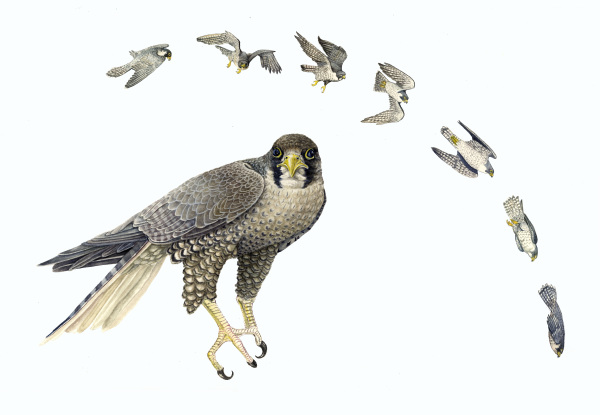
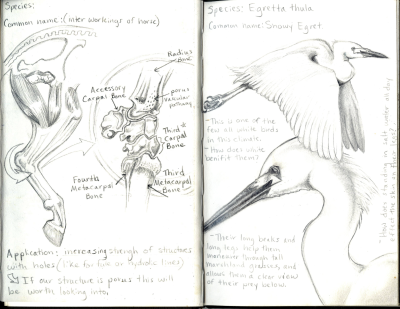
Two pages from my own work
My peregrine falcon drawing shows the bird at rest, and behind it a sequence of the same bird turning into a stoop, its wings drawing closer to the body with each step until it is a compact, streamlined shape. Peregrines are often described as the fastest animals on record in a dive, and researchers have built models of the stooping bird to study how its shape handles air at speed. A sequence drawing shows something no single photograph can: how the shape changes over time. Change in shape is often where the useful idea is hiding.
The other page is from a field journal. Next to a drawing of the bones in a horse's leg, I wrote a note to myself: "Application: increasing strength of structure with holes." Then: if our structure is porous, this will be worth looking into. Many bones are not solid all the way through. Inside the ends of long bones is spongy bone, a lattice of thin struts that follows the lines of stress, strong where strength is needed and light everywhere else. Engineers now design lightweight lattice parts on similar principles. I did not invent anything on that page, but I asked the right kind of question, and drawing the bone is what made me ask it.
Try it yourself: a biomimicry sketching exercise
- Pick a problem, not an organism. Staying dry, staying cool, gripping, being light but strong, moving quietly.
- Find something that already solves it. A beetle in the rain, a leaf in full sun, a tree frog on glass, a hollow feather shaft.
- Draw it at three scales. The whole organism, the part that does the job, and a magnified or cut-away detail of that part.
- Write function notes. Beside each drawing, write what the structure does and how you think it does it. Mark guesses as guesses.
- Check the biology. Look it up, or better, ask someone who studies it. Nature is not optimized for our goals; every structure is a compromise between many jobs.
- Sketch an application. Only now, draw how the principle might work in a human design.
The method is the same one I use in my field journals, which I describe in How to Keep a Nature Field Journal. The questions are "how, why and why not?"
A note of caution
Biomimicry stories are appealing, and some get simplified in the retelling. A good biomimicry illustration should be as careful as any other scientific illustration: drawn from specimens and research, checked by a specialist, and honest about what is known and what is still a hypothesis.
If you work in design, engineering or science education and need to explain a biological principle visually, from a magnified surface to a cross-section or a sequence over time, see my illustration services or get in touch.