Observing wildlife where it lives is the start of almost everything I draw, and my field journal is where that observing happens. On its pages I keep asking the same three questions: how, why and why not? Here is how I keep a journal, and how you can start one.
Why keep a field journal at all
I grew up on a rugged property in the South Carolina wetlands near the Pee Dee River, with no neighbors for 20 miles in any direction. I learned early that the more time you spend looking at a place, the more it shows you. A field journal turns that looking into a habit. Drawing forces you to notice, because you cannot draw a tree frog's foot without counting its toes. Writing makes you ask questions. Over months and years the pages become a record of a place that nobody else has.
A simple kit
The best kit is the one you actually carry. Mine fits in a small pouch:
- A sketchbook of heavy mixed-media paper, small enough to hold in one hand. Pages that take a light watercolor wash without buckling are worth paying for.
- Two or three pencils (an HB plus a softer 2B or 4B) and a kneaded eraser.
- A waterproof pigment ink pen for labels and for lines I want to keep.
- A water brush and a small pan set of watercolors, or a handful of colored pencils.
- A short ruler marked in millimeters, and a hand lens. A 10× lens opens up lichens, insects, seeds and flower parts.
- Two binder clips to keep pages still in the wind, and a zip bag in case of rain.
A regional field guide is useful, but I usually leave identification for later, at home. In the field, looking comes first.
What to record on every page
Start each entry the same way, before you draw anything:
- Date and time.
- Place, as specifically as you can: not just the park, but the trail, the pond edge or the particular tree.
- Weather: temperature (an estimate is fine), sky, wind, and whether it has rained recently.
- Habitat: wetland, pine woods, a backyard hedge, a sandy roadside.
It takes a minute, and it makes the journal useful later. When you want to know when the frogs started calling last spring, or how high the water was when the egrets came through, the answer is at the top of the page.
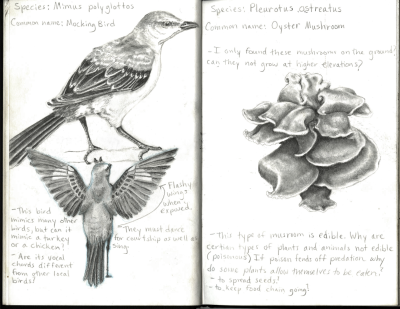
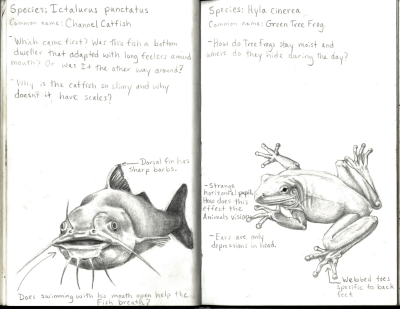
Then record what you see, and write down your questions. On one spread I drew a northern mockingbird (Mimus polyglottos) and asked: it mimics so many other birds, but could it mimic a turkey or a chicken? Are its vocal cords different from those of other local birds? Next to a channel catfish (Ictalurus punctatus) I asked which came first: was it a bottom dweller that developed long feelers around its mouth, or the other way around? Some of these I answered later with a book. Some I am still thinking about. The questions are the point, because they tell you what to look for next time.
Gesture first, details later
Animals move. If you wait for a bird to sit still you will wait all day, so I start with gesture sketches: quick drawings, thirty seconds to two minutes each, that capture the overall shape, posture and line of action. Draw the big shapes first, an oval for the body and a smaller one for the head, then the angle of the tail and legs. Put several gestures on one page, and when the animal returns to a pose, go back to that sketch and add to it. Don't erase; draw it again.
Plants, fungi and shells are more patient. That is where I slow down and draw details: how the leaves attach to the stem, the pattern of the veins, the gills under a mushroom cap.
Measure what you can
Proportion is what makes a drawing believable, and measuring is how you get it right.
- For distant subjects, hold your pencil at arm's length and compare one part with another: how many head lengths make up the body, how long the legs are compared with the wings.
- For plants and objects you can reach, use the ruler and write the size in millimeters beside the drawing, or add a small scale bar.
- Count things: petals, toes, fin spines, pairs of leaves. Counts are often what identify a species.
- Mark estimates as estimates. "About 40 cm (est.)" is honest and still useful.
Color notes
Light changes quickly, and animals leave. Rather than rushing to paint, I write color notes with arrows: "olive above, cream below," "yellow wash on the flanks," "eye bright orange." A row of small swatches in the margin, each labeled with what it matches, helps when you paint later. Note the light as well, because a white egret in shade is not the same color as one in full sun. Accurate words are better than a muddy wash.
Labels and names
Write the common name and, when you know it, the scientific name, the way I head each page in my own journals. If you don't know what something is, write a question mark and describe it well enough to identify later. Use leader lines to point your notes at the features you noticed. On my green tree frog (Hyla cinerea) page I noted the horizontal pupil and asked how it affects the frog's vision, and I noted that the webbing is on the back feet. Those small notes are what made the drawing worth keeping.
Make it a daily habit
Ten or fifteen minutes a day does more than a long outing once a month. Pick a sit spot, whether a window, a backyard or the same bend in a creek, and keep returning to it. You will see the seasons change in detail: which plants flower first, when the birds change, what appears after rain. You do not need anything rare. Knowing common species well is a real skill.
Ethics in the field
A journal is about observing, and observing should leave a place as you found it.
- Follow leave-no-trace practice: stay on trails where asked, pack out what you bring, and put back any rock or log you turn over the way you found it.
- Keep your distance from wildlife. If an animal changes its behavior because of you, you are too close. Never approach nests or dens.
- Avoid handling amphibians. Their skin is thin and absorbent, and whatever is on your hands ends up on them.
- Clean and dry your boots and gear between ponds and wetlands so you don't carry pathogens such as the chytrid fungus from one site to the next. I have drawn its life cycle, and it has been linked to serious amphibian declines around the world.
- Don't collect plants, shells, feathers or anything else unless you know it is legal and harmless where you are. Many protected areas forbid collecting, and many birds' feathers are protected by law. A drawing is the better souvenir.
From journal page to finished illustration
Many of my finished illustrations begin on a journal page. The page holds the first observations and, more importantly, the questions. When I turn one into a finished piece, I go back to those questions and research them, gather more references and, when I can, study specimens. Then I make small thumbnail sketches to decide what the final image needs to show, followed by a careful drawing and the finished art in graphite, ink, watercolor or digital paint.
The journal also keeps me honest. A finished illustration combines many references, but the field notes remind me how the animal actually moved, what the light was like and what surprised me. Sometimes a page leads somewhere unexpected. Beside a drawing of the bones in a horse's leg, I once wrote a note wondering whether holes could make a structure stronger, a biomimicry question rather than a biology one.
If you start a journal after reading this, keep it simple, keep it with you, and keep asking how, why and why not. You can see more of my journal pages on the Journal page and finished work in the gallery. For an introduction to the field itself, read What Is Scientific Illustration?